
|
"How much will my floor cost?" is the first question almost every client asks us, and the honest answer is: it depends on what lies beneath it. In Edinburgh in 2026, a professionally fitted real wood floor typically costs £120–£330 per m² all-in, once the wood, the fitting and the subfloor preparation are added together. A straight-laid engineered oak plank sits at the lower end. A glued herringbone or chevron over a levelled Victorian or Georgian floor sits at the upper end. In this guide we break down every part of that price, so you know exactly what you are paying for and can compare quotes with confidence. Edinburgh wood flooring prices at a glance (2026, per m², excluding VAT)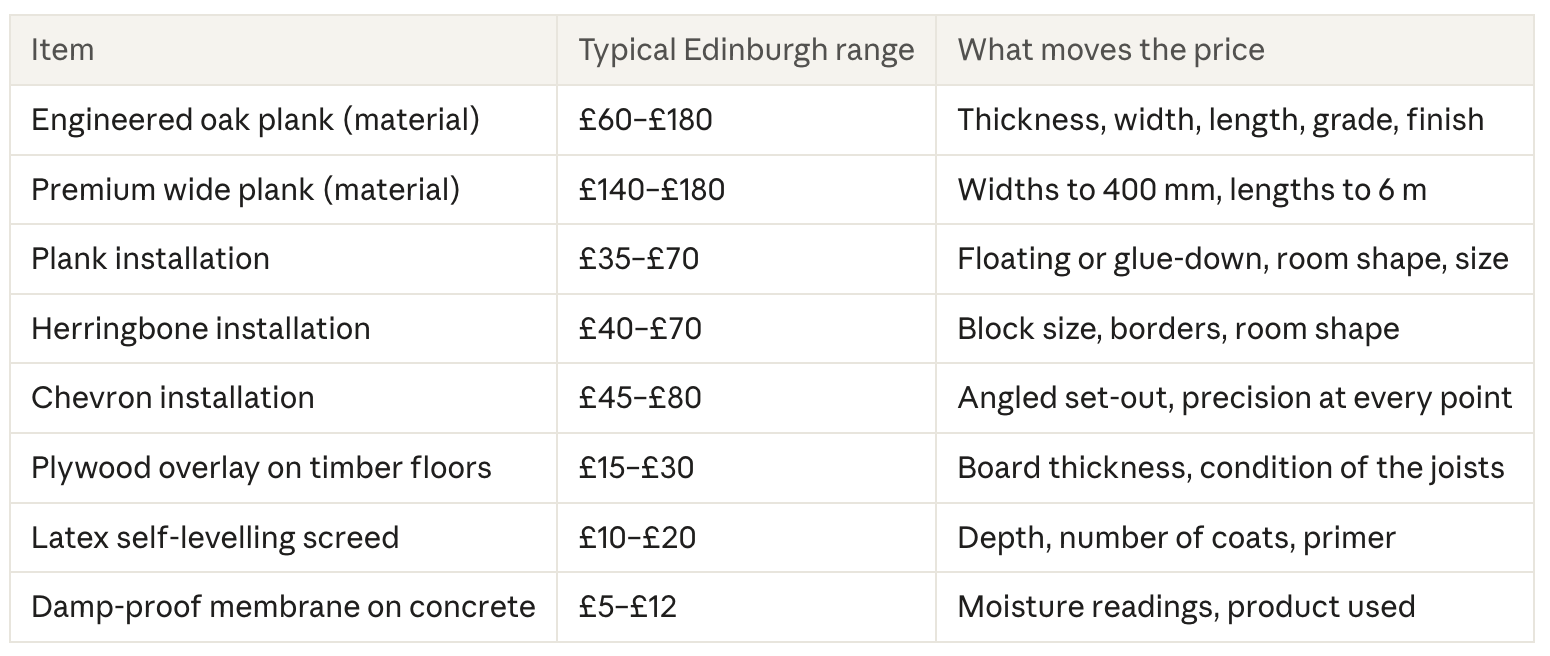 These figures are a guide. Every property is different, which is why we always confirm a final price after a free site survey. For the full breakdown of our plank pricing, see our Engineered Oak Wood Flooring Cost Guide. What actually drives the priceFive factors decide most of the final figure. Once you understand them, comparing quotes like for like becomes much easier.
The cost per m² also falls as the area grows, because fixed costs such as travel, set-out and machine hire are spread across more floor. A 10 m² hallway will usually cost more per m² than a 40 m² open-plan living space in the same oak. Material costs: what you pay for the woodOur engineered oak ranges from £60 to £180 per m², with extra-wide and extra-long boards at £140–£180 per m². You will find engineered boards for less elsewhere, but the difference is almost always in the construction, which becomes invisible the moment the floor is down. Engineered or Solid Wood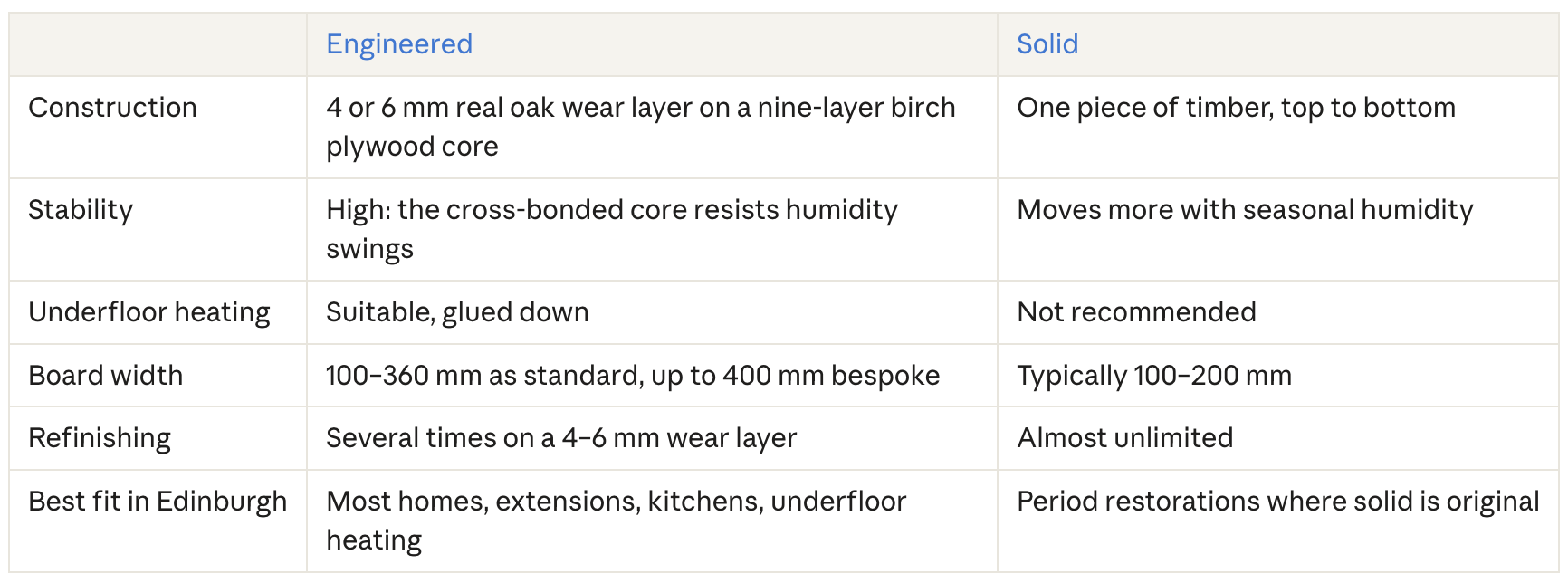 Engineered is our recommendation for most Edinburgh homes, and it is not a compromise. It copes with central heating, sits happily over underfloor heating and allows the wide, long boards many clients now want. Our technical specificationsets out exactly how our boards are built. Other speciesOak is the Edinburgh favourite, but it is not the only choice. Ash is priced close to oak. Walnut sits at a clear premium, with European walnut scarcer still. Douglas fir offers very large boards at good value per m², but is softer and marks more easily. Reclaimed oak varies with source and condition. Parquet blocks versus planksHerringbone and chevron blocks often cost a little more per m² than plank in the same grade, because each block is machined individually with tongue and groove on all four sides. Chevron blocks also carry the cost of an accurate angled end cut. Panel parquet such as Versailles and mansion weave is assembled from many small pieces and priced as a premium product. The best way to judge the difference is to see it. Visit our Morningside showroom or order samples to compare grades and finishes at home. Installation labour: what the fitting costsProfessional wood flooring installation in Edinburgh typically costs £35–£70 per m² for plank, depending on the method, the complexity of the room and its size. Our own fitters are in-house, not subcontracted, which is how we keep the quality consistent from survey to final coat. By installation method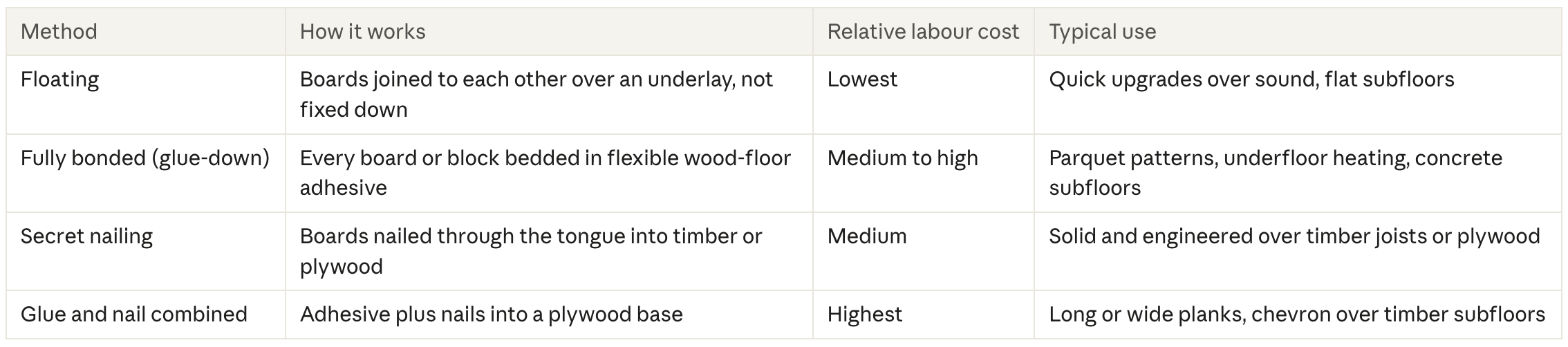 For bonded floors, allow roughly £5–£10 per m² for professional parquet adhesive. We use trusted systems from Stauf and Bostik. A floating floor needs an underlay instead, typically £5–£15 per m² supplied and fitted. Per m2 or day rate?Most of our work is priced per m², because it gives you a fixed figure to budget against. Small, awkward or restoration jobs, where output per day is hard to predict, are sometimes better priced by the day. Across the UK, a two-person flooring team typically charges £300–£500 per day. How long in takes?A single room of straight plank is often laid in one to two days. Herringbone and chevron take roughly twice as long per m², and preparation adds its own days before laying starts. As a guide from our own projects, our team has laid 117 m² of plank in three days and 76 m² of chevron in four, with the subfloor already prepared. Before any of that, the boards need at least 72 hours to acclimatise in the room. Our free installation guides cover each method in technical detail. Subfloor preparation: the cost most quotes underplayIn a typical Edinburgh period property, subfloor preparation adds £15–£50 per m² to a job, and occasionally more where joists need repair. It is the single biggest reason two quotes for the same room can differ by thousands of pounds. A wood floor is only as good as what lies beneath it. We work to a flatness of 2–3 mm under a 2 m straight edge and test moisture before any adhesive goes down. Parquet is less forgiving than plank: herringbone and chevron multiply the number of joints, and every joint shows any unevenness below it. We explain why in more depth in Why Subfloor Preparation Is the Foundation of a Successful Wood Floor. Timber subfloors (most tenements, Georgian and Victorian houses)Most of Edinburgh's older flats and houses have their original softwood boards nailed to deep joists. After a century of settlement, many floors dip towards the middle of the building or roll gently across the room. In tenements there is often a layer of "deafening" (ash or similar) between the joists, laid to reduce sound between flats. 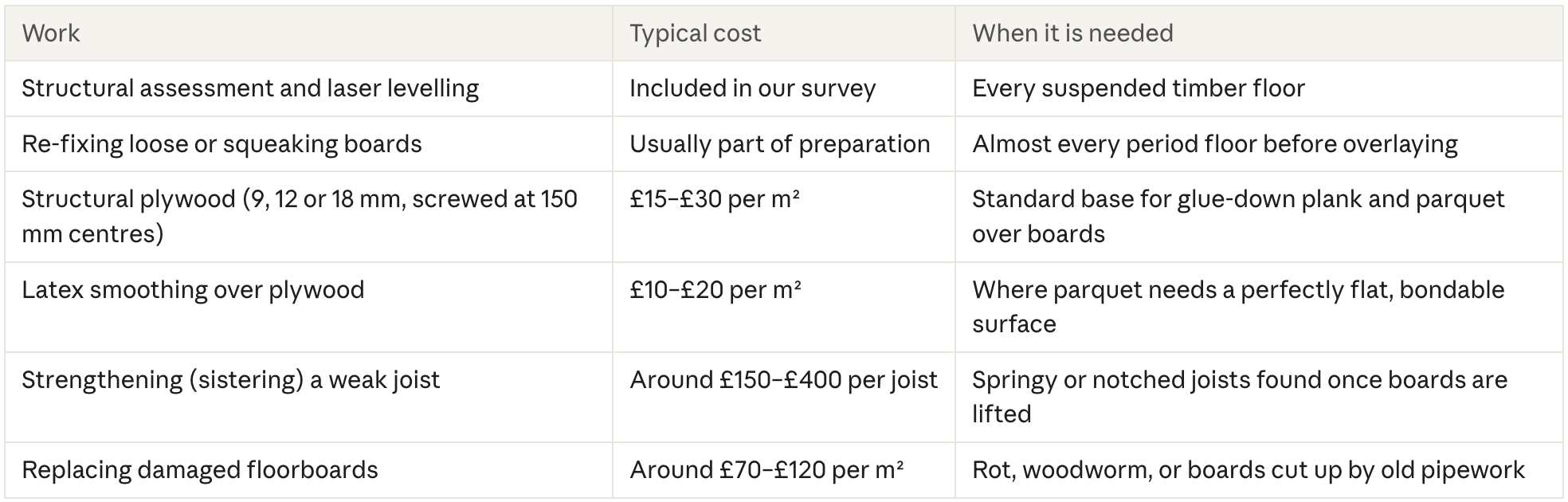 Concrete and screed subfloors (extensions, new builds, some ground floors)New screed also needs time to dry, roughly a day per millimetre for the first 50 mm, so it affects your programme as much as your budget. 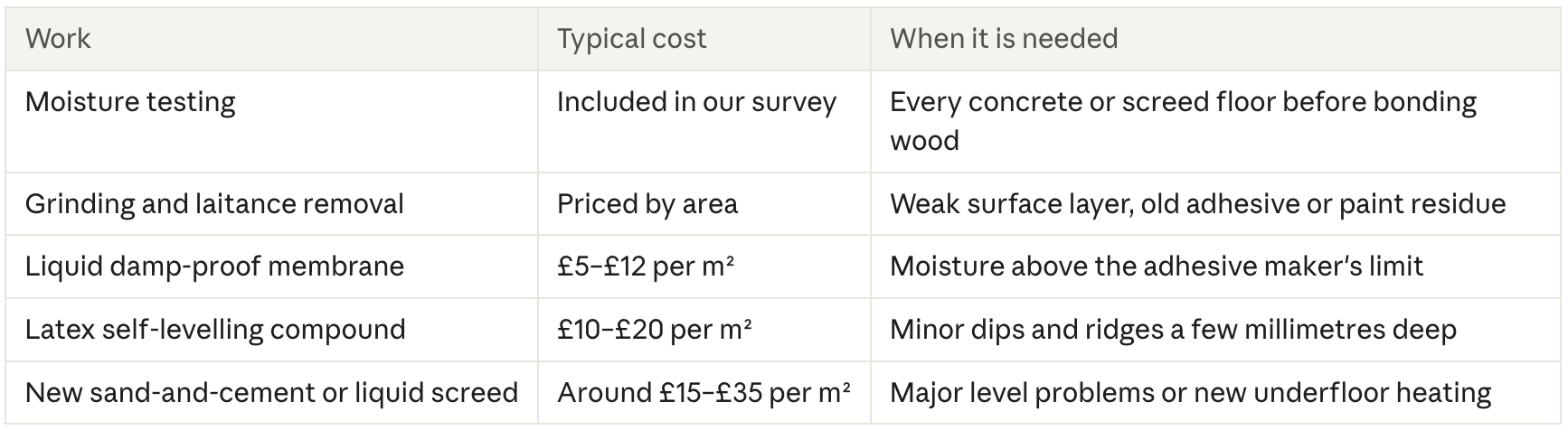 Removing what is there nowLifting and disposing of old carpet, laminate or tiles usually costs around £5–£10 per m². Tiles bedded in cement, or old blocks laid in bitumen, cost more because every trace of residue has to come off before anything new can be glued. Sound proofing in flatsIn a flat, your floor is someone else's ceiling. Our soundproofing for wood floors uses rubber crumb mats, dense fibre boards and acoustic layers matched to the floor above, typically reducing impact noise by 15–30 dB. As a guide, acoustic matting systems cost around £18–£30 per m², and multi-layer systems £35–£55 per m². Where the original deafening between the joists has been removed, reinstating it is a separate job and is priced on its own. Parquet patterns: how each one changes the priceThe pattern is the biggest single factor in labour cost. As a rule, herringbone costs roughly half as much again to fit as straight plank, chevron costs more than herringbone, and panel parquet such as Versailles is priced project by project. Patterns also need more material, because the diagonal cuts at every wall produce more offcuts. Browse the full range in our parquet flooring collections. 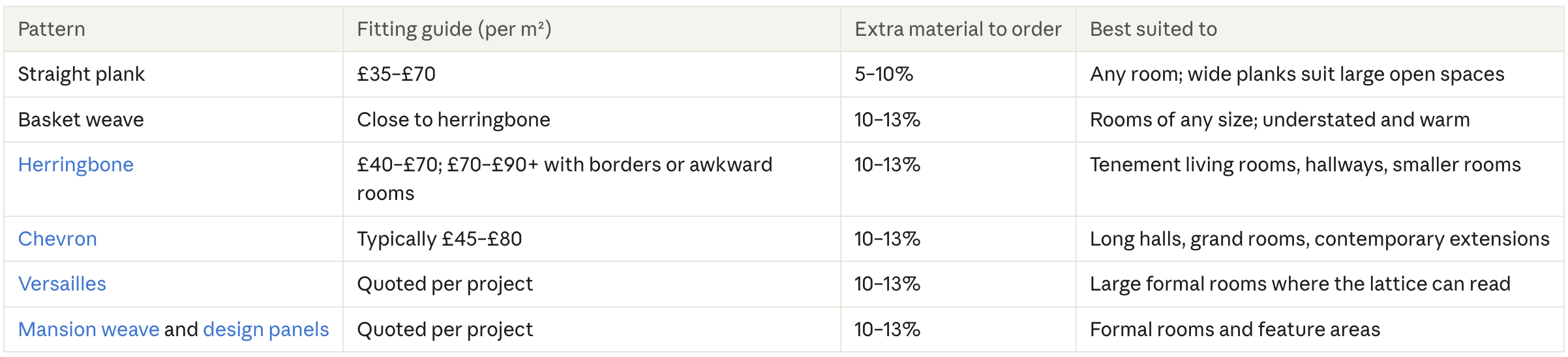 Herringbone Rectangular blocks laid at 90° to each other in a staggered zigzag. It is the pattern we are asked for most in Edinburgh, and it suits the proportions of Victorian and Georgian rooms beautifully. Herringbone visually widens narrow rooms and hallways, and its busy grain hides everyday wear. Block size matters: narrow blocks (80–100 mm) give a traditional, lively look, while wider blocks (120–140 mm) are calmer and suit larger rooms. Our most specified sizes are 16/100/600 and 16/120/700. A recent 110 m² herringbone parquet project in Morningside shows how well it carries through a whole ground floor. Chevron Blocks with ends cut at an angle, usually 45° (we make bespoke angles from 30° to 60°), meeting in a continuous point down the room. Chevron parquet reads more modern and draws the eye along the length of a space, which is why it suits long halls and grand rooms. It usually costs more than herringbone both to make and to fit, because every point must meet precisely along the centre line. Our most popular chevron specification is 16/140/700. Versailles and panel parquet Versailles panels are square, interlaced lattice panels, typically 800 × 800 mm, first laid in the 17th-century French palace that gave them their name. We also make bespoke panels: in Braid Hills we fitted handmade smoked oak Versailles at 1000 × 1000 mm. Panels go down faster than loose blocks, but the room needs careful setting out so the grid sits centrally and the cut panels at the walls are balanced. Mansion weave and basket weave Mansion weave combines three block shapes with the grain running in different directions. It is formal, suits large rooms and is among the more complex patterns to lay; read more in our deep dive on mansion weave parquet. Basket weave is a simpler grid of paired blocks, quicker to fit and comfortable in rooms of any size. Borders, inlays and feature strips A single- or double-block border frames a pattern and neatly resolves junctions at doorways, bay windows and hearths. Border installation is usually priced by the linear metre, typically £15–£25 per linear metre, plus the border material. Metal inlays are bespoke: at Duddingston House Estate we combined herringbone with a custom brass inlay. See more in our architectural details range. Why set-out matters Every pattern must be set out from an accurate centre line, never from a wall. Edinburgh walls are rarely straight, and a pattern started from one will drift visibly across the room. We set out every parquet floor with a laser line from the centre of the room. That time is part of why pattern labour costs more, and it is not somewhere to look for a saving. Extras to budget forThe per-m² price rarely covers everything. These are the items that most often appear as separate lines on a quote, or get missed until the job starts. 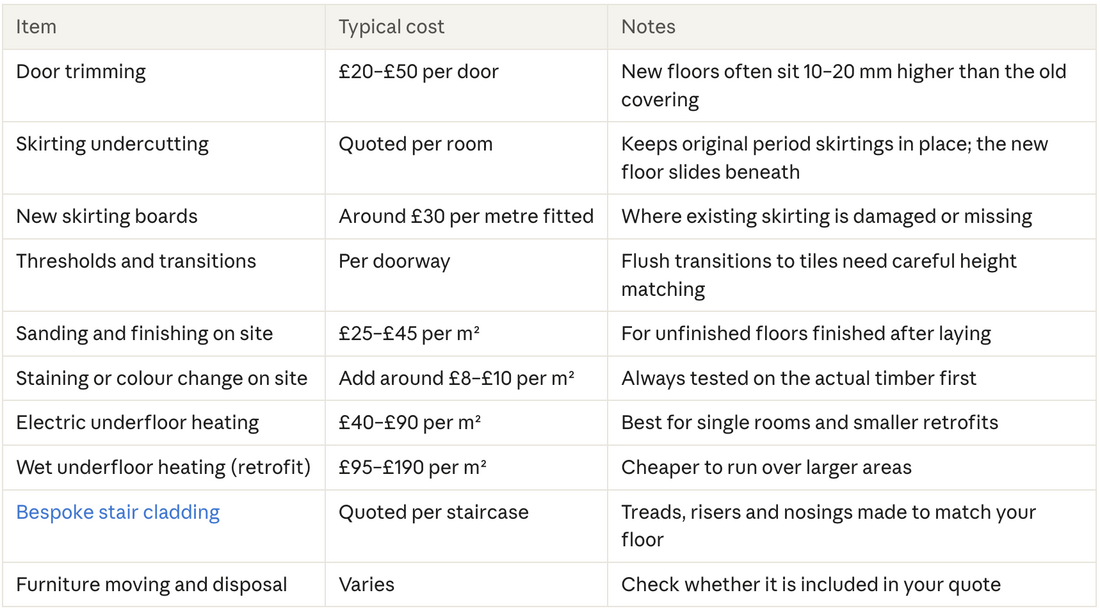 Wood flooring over underfloor heating Engineered wood is the right choice over underfloor heating; solid wood is not. The floor should be fully bonded with an adhesive rated for heating. The system must be commissioned and run before installation, switched off for 24 hours before and during fitting, then brought back up gradually, by no more than 5°C a day. For our floors, the surface temperature should not exceed 26°C. None of this adds much to the flooring price, but skipping it is a common cause of gaps and cupping. Our boards' low thermal resistance (0.09 m²K/W at 16 mm) lets heat pass through efficiently. Factory-finished or finished on site? Most of our engineered floors arrive factory-finished in hardwax oil or lacquer with a micro-bevel on the edges, so the room is ready to use soon after fitting. Unfinished oak is sanded and finished once laid. This costs more and takes longer, but gives a seamless, flush surface that many clients love for parquet, and lets us fine-tune the colour in the room itself. Already have a wood floor that needs new life? Our floor sanding and restoration service may be the more economical route. Staircases A new floor often leads the eye straight to the stairs. We make treads, risers and nosings to match your floor exactly, including curved and bespoke pieces, so the hall and staircase read as one. Because every staircase is different, we price stair cladding individually after measuring. What makes Edinburgh differentEdinburgh's homes are some of the most beautiful in Britain, and some of the most demanding to floor. Stone tenements, Georgian and Victorian townhouses and New Town flats each bring their own preparation, access and neighbour considerations. We cover the design side in Choosing the Perfect Flooring for Victorian and Georgian Homes in Edinburgh; here is how these homes affect the price. Tenement flats
Georgian and Victorian houses and New Town properties
Parking, access and noise Much of central Edinburgh sits within controlled parking zones, so parking for a fitting team is a real cost on many city-centre jobs. We cut indoors where possible to keep noise and dust down, and in shared buildings we are happy to let neighbours know our working hours in advance. Climate and acclimatisation Edinburgh's damp, cool climate and well-heated interiors create big swings in indoor humidity between summer and winter. Timber needs at least 72 hours to acclimatise in the room before fitting, and a stable engineered construction is the safest choice where heating runs hard. Keeping indoor humidity at roughly 40–60% keeps any wood floor at its best; our cleaning and maintenance guide covers the rest. Worked examples: typical Edinburgh budgetsTo bring it all together, here are four typical Edinburgh projects of the kind we survey every week. Each budget includes material with a waste allowance, labour, subfloor preparation, adhesive and removal of the old covering. They exclude VAT, underfloor heating and stairs. 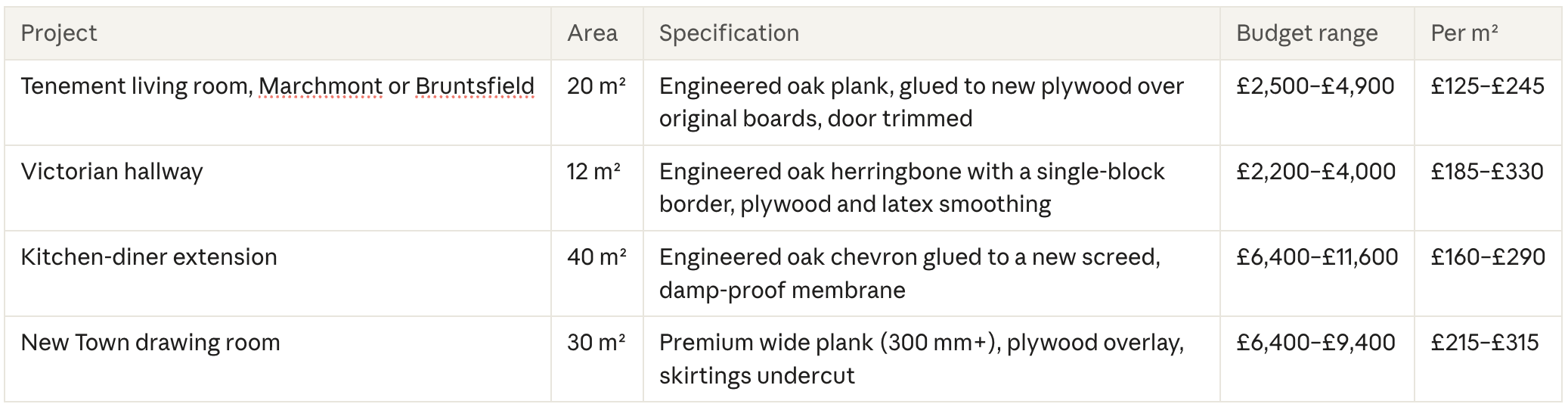 The low end of each range assumes a rustic or natural grade, a sound subfloor needing only a standard overlay, and easy access. The high end assumes a select or premium grade, more levelling, and awkward rooms or stairs. Small rooms like hallways always cost more per m², because set-out, cutting and travel are spread over fewer square metres. How the hallway example adds up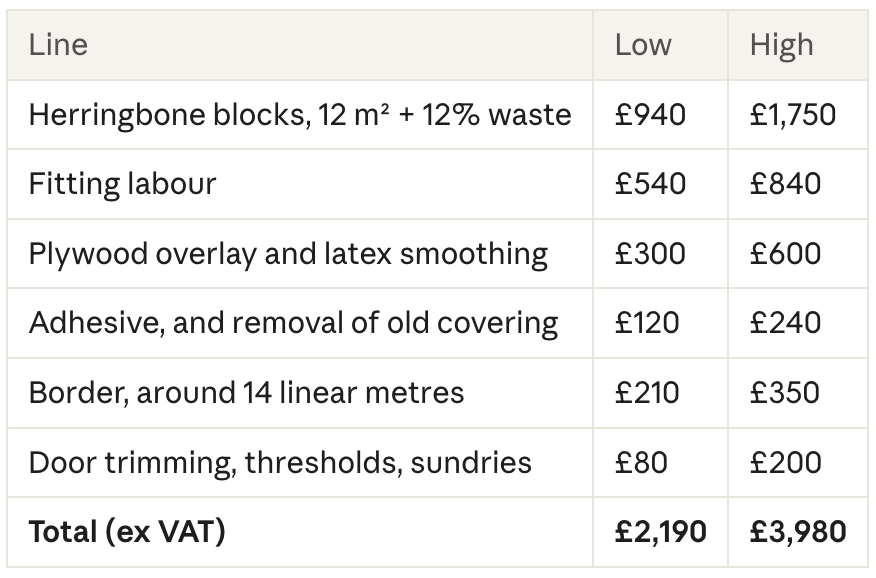 Use this structure to check any quote you receive. If a line is missing, ask whether it is included or will be charged later. Our quotations itemise every one of these lines, so there are no surprises once work begins. Getting an accurate quoteA reliable price needs a site survey. No online figure, including the ones in this guide, can see your subfloor. When you compare quotes, check that each one states:
If one quote is far cheaper than the others, the difference is usually in preparation or product specification, not efficiency. Frequently asked questionsHow much does it cost to lay a herringbone floor in Edinburgh? For engineered oak herringbone, allow roughly £180–£330 per m² all-in, including material, fitting, preparation and a border. Fitting alone typically runs £40–£70 per m², more with borders or awkward rooms. Is chevron more expensive than herringbone? Usually, yes. Chevron blocks need a precise angled cut, and every point must meet exactly along the centre line, so both the material and the fitting tend to cost more. Why is subfloor preparation so important in Edinburgh? Most of the city's tenements and period houses have original timber floors that have settled over a century. Wood flooring, and parquet in particular, needs a flat, stable base, so plywood overlays and levelling are standard rather than optional. Can you lay a wood floor over my existing floorboards? Often, yes, once loose boards are re-fixed and structural plywood is installed to create a flat, bondable surface. Badly damaged, rotten or springy floors need repair first, which we assess during the survey. Can I have wood flooring in a tenement flat? Usually, but check your title deeds for conditions on floor coverings first, and include proper acoustic treatment. Your downstairs neighbour will hear the difference. How much extra material should I order? Around 5–10% for straight planks and 10–13% for herringbone and chevron. How long does it take? Our flooring is usually ready 3–8 weeks after your order is confirmed. On site, a single room of plank often takes one to two days, while herringbone and chevron take roughly twice as long. Preparation, and drying time for any new screed, comes first. Is engineered wood suitable with underfloor heating? Yes, when it is fully bonded with a suitable adhesive and the heating is commissioned correctly. Solid wood is not recommended over underfloor heating. What guarantee do I get? Our engineered flooring carries a 25-year residential structural warranty, and our installation work is guaranteed for 3 years. Ready to price you floorEvery floor we fit starts with a free survey, so the price you receive reflects your home, not a guess. Visit our showroom at 37 Comiston Road, Morningside to see our floors in person (we are often out on site, so please call ahead), order samplesto compare at home, or contact us on 0131 385 7779 to arrange your survey. Browse finished projects in our gallery for inspiration.
Architects, interior designers and developers can also benefit from preferential pricing through our trade programme. Related reading
All prices are guide figures for 2026 and exclude VAT unless stated. Your final price is confirmed after a free site survey.
0 Comments
Your comment will be posted after it is approved.
Leave a Reply. |
About Hoff ParquetHOFF PARQUET - wood flooring company based in Edinburgh. We are your go-to company for the best real wooden floors like Chevron Parquet & Herringbone Parquet, Engineered wood floors & Solid wood flooring for any residential or commercial project. Our dream is to create unique luxury hardwood elements including wooden floors, wood for wall cladding, wood for stairs and bespoke parquetry.
At Hoff Parquet think GREEN. We were inspired to create a greener and more environmentally friendly company and product inventory. Only the highest quality eco friendly materials used for our wood flooring products, cladding and decking during the production & installation process. Our custom-made flooring designed and made by experienced craftsmen offers premium quality, trendy shapes and colours. In collaboration with interior designers and architects we create the flooring which becomes a truly unique interior detail. We hereby confirm that all our wood flooring products are made in the European Union. Furthermore, all our wood materials are backed with FSC (Forest Stewardship Council) and PEFC (Programme for the Endorsement of Forest Certification Schemes) manufacturers' certificates, ensuring that our products meet the highest standards of sustainability and environmental responsibility. We are always open for innovations, new contacts and we are constantly in search for new partners! |
|

© COPYRIGHT 2026 ALL RIGHTS RESERVED.