Ask ten people what makes a wood floor beautiful and most will talk about the timber – the oak, the grade, the width of the boards. Ask a fitter and they will tell you it is the finish. The finish decides how the wood looks in daylight, how it feels under bare feet, what happens when someone drops a glass of red wine, and how much work the floor will ask of you over the next twenty years.
We finish floors every week, in our workshop and on site, so this guide is written from the floor up. It covers the four finishes you will be offered for engineered and solid wood flooring – natural oil, hardwax oil, UV oil and lacquer – what each one is made of, how it behaves, and which one we would choose for which room.
The short answer
- Natural oil – the most natural look and feel, easy to repair in patches, but needs the most regular care.
- Hardwax oil – an oiled look with better resistance to water and stains. The best all-rounder for most homes, and our default.
- UV oil – an oiled look cured hard in the factory, so the floor is fully protected from the day it is laid. Low maintenance for an oiled floor.
- Lacquer – a protective film on top of the wood. The toughest everyday protection against spills and the least routine care, but scratches and worn patches are harder to repair invisibly.
What a wood floor finish actually does
Bare wood is porous. Water, grease and dirt soak straight into it, and foot traffic wears the fibres quickly. A finish does two jobs: it seals the surface so spills stay on top long enough to be wiped away, and it takes the wear so the wood underneath does not.
There are two very different ways of doing that:
- Penetrating finishes (natural oil, hardwax oil, UV oil) soak into the top fibres of the wood and harden inside them. The wood itself becomes the wearing surface. You can still feel the grain, and the floor looks like wood rather than wood behind something.
- Film-forming finishes (lacquer, sometimes called varnish) build a thin, continuous layer on top of the wood. The film takes the wear, and the wood never touches your feet.
Almost every difference you will read about below – look, feel, maintenance, repair – comes back to that one distinction.
Natural oil
Traditional floor oils are made from drying plant oils – linseed is the classic, with sunflower, soya and tung oil also common – thinned so they penetrate, often with a small amount of drier to speed things up. They do not dry by evaporating like paint. They cure by oxidation: the oil reacts with oxygen in the air and slowly cross-links into a solid inside the wood fibres.
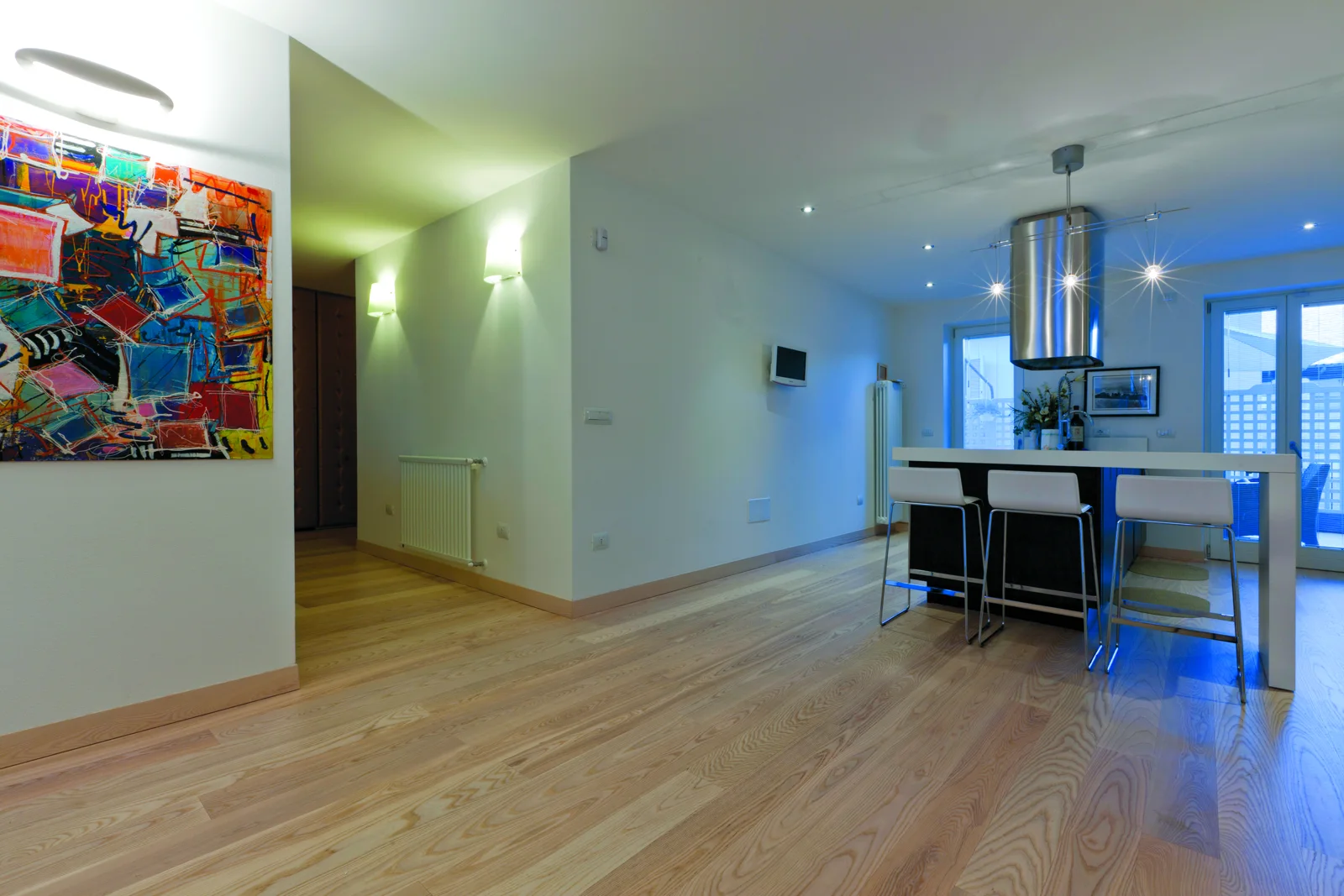
What you get: the most natural finish there is. The grain looks deep and three-dimensional, the floor feels warm and slightly textured, and there is no sheen to catch the light. Oil also tends to bring out the warmth of oak, giving it a gentle golden tone.
The trade-off: oil leaves the surface the most open of all the finishes. Water left standing will leave a mark, and a natural oiled floor needs topping up more often than any other. In a typical home that means a maintenance oil once a year in busy areas and every year or two elsewhere; in a shop, bar or restaurant it can be every three to six months.
The big advantage: repair. Because there is no film, a worn or damaged patch can be lightly sanded and re-oiled, and it blends back into the rest of the floor. No hard edge, no visible patch.
Best for: people who love the look of raw timber and do not mind a little regular care – and for period restorations where a modern sheen would look out of place.
Hardwax oil
Hardwax oil is the finish we use most, and the one we recommend for most homes. It combines penetrating plant oils (typically linseed, sunflower, soya or tung) with hard natural waxes such as carnauba and candelilla. The oil soaks into the wood and cures there, as with a traditional oil, while the wax stays near the surface and forms a very thin, tough micro-layer that seals the pores. It is not a film in the way a lacquer is – you can still feel the wood – but it gives noticeably better protection than oil alone.
- Coats: usually two thin coats on bare wood, applied with a roller, spatula or buffing machine and worked well into the grain.
- Drying and curing: most hardwax oils can be recoated after around 8–12 hours and walked on carefully after 24 hours, but they need 5–7 days to cure fully. Keep rugs off and avoid wet cleaning for the first week. Cold rooms slow everything down – below about 15°C drying times can easily double.
- Sheen: available from matt to satin, and in tinted versions – white, grey, smoked and darker tones – which colour the wood at the same time as protecting it.
- Repair: like natural oil, damaged areas can be spot-repaired without sanding the whole floor.
Chemical-resistance testing to the European standard EN 13442 shows how much the application rate matters. Applied heavily (around 140 g/m²), hardwax oil resists almost every household liquid but starts to lose its natural, oiled appearance. Applied at a more typical 30 g/m², it still resists most everyday spills well – with one important exception: ammonia. Ammonia is the weak point of almost every wood floor finish, which is why we tell every client to keep glass cleaners and other ammonia-based products well away from their floor.
Best for: family homes, kitchens and open-plan living areas, hallways, and anyone who wants the look of an oiled floor without the worry.
UV oil
UV oil is an oil designed to be cured in a factory rather than in your living room. The boards travel along a finishing line where rollers apply carefully measured coats – some lines apply as many as seven – and each coat passes under high-intensity ultraviolet lamps. The oil contains photo-initiators that react to UV light, so it hardens in seconds instead of curing slowly by oxidation over days.
What that means for you: a pre-finished floor with the look of an oiled floor that is fully cured and protected from the day it is laid. There is no waiting a week before you can put rugs down, and no smell of drying oil in the house. Most manufacturers do not require an extra coat of oil after installation, although it is always worth checking the care guide for the specific floor.
Maintenance: UV-oiled floors are looked after like other oiled floors – a pH-neutral cleaner for routine cleaning, and a compatible refresher or maintenance oil when high-traffic areas start to look dull. They generally need that less often than a site-oiled floor. UV oils are also often formulated to resist fading in strong sunlight.
The catch: you cannot reproduce a UV finish on site, because it needs the curing lamps. If a UV-oiled floor is ever fully sanded back, it is refinished with a conventional oil or hardwax oil. That is not a problem – it is simply worth knowing, especially on engineered boards where the number of full sandings is limited by the thickness of the wear layer.
Best for: new homes and renovations on a tight programme, rental properties, and people who want an oiled look with the least possible fuss in the first years.
Lacquer
Lacquer is the film-forming option. Modern floor lacquers are mostly water-based polyurethane or acrylic-polyurethane products, which have largely replaced the solvent-based varnishes of the past. They come in two types:
- One-component (1K) lacquers dry and harden on their own. They are perfectly adequate for most domestic rooms.
- Two-component (2K) lacquers are mixed with a hardener just before use. The hardener cross-links the film, making it noticeably harder and more resistant to chemicals and scuffing. This is the choice for busy commercial floors – shops, offices, restaurants and schools – and for demanding rooms at home.
On site, a lacquer system is usually a primer (sometimes coloured) followed by two or three top coats, with a light sand between coats. A typical water-based 2K lacquer can take light foot traffic after about 8 hours and is fully cured after around 72 hours, though some products need up to a week. Factory-finished lacquered boards are tougher still: our pre-finished lacquered floors receive eight coats in the factory.
Lacquer sheen levels
Lacquers are sold by sheen, measured as the percentage of light reflected at a 60° angle. As a rough guide:
| Sheen | Approximate gloss level | How it looks |
|---|---|---|
| Extra / ultra matt | below 10% | Almost invisible – the closest a lacquer gets to raw or oiled wood |
| Matt | below 20% | Soft, low reflection; hides micro-scratches and dust well |
| Satin (silk matt) | about 25–45% | A gentle glow; shows marks a little more |
| Gloss | above 60% | Mirror-like; shows every scuff and footprint in strong light |
Almost all of our clients choose ultra matt or matt. Modern ultra matt lacquers have done a great deal to close the visual gap between lacquered and oiled floors.
Strengths: the best protection against standing liquids and stains, the easiest day-to-day cleaning, and no routine re-oiling. Water-based lacquers also change the colour of the wood very little, which makes them a good choice when you want pale oak to stay pale.
Weaknesses: repairs. A deep scratch that cuts through the film, or a worn path through a doorway, cannot simply be touched in – the area usually has to be sanded and recoated, and the edge of a patch repair can show. The secret is to maintain the film before it wears through: a light abrade and a fresh top coat every few years in busy areas keeps the wood underneath untouched. Our guide to resealing and overcoating lacquered floors explains the process.
Best for: kitchens and family rooms where spills are part of life, commercial interiors, rental properties, and anyone who would rather never think about maintenance oil.
Oil, hardwax oil, UV oil and lacquer compared
| Natural oil | Hardwax oil | UV oil | Lacquer | |
|---|---|---|---|---|
| How it protects | Penetrates and cures inside the wood | Penetrates, with a thin wax-hardened surface | Penetrates, cured hard under UV in the factory | Film on top of the wood |
| Look and feel | Most natural, warm, textured | Natural, slightly smoother | Natural oiled look | Smooth; from ultra matt to gloss |
| Spills and stains | Wipe up quickly | Good | Good | Best |
| Scratches | Show less, easy to blend | Show less, easy to blend | Show less, easy to blend | Can show white in the film, harder to repair |
| Routine care | Most | Moderate | Low to moderate | Least |
| Spot repair | Yes | Yes | Yes, with a compatible oil | Difficult; usually sand and recoat an area |
| Applied on site? | Yes | Yes | No – factory only | Yes, or factory pre-finished |
| Ready for full use | About a week | 5–7 days | Immediately | About 3–7 days on site; immediately if pre-finished |
How each finish changes the colour of your floor
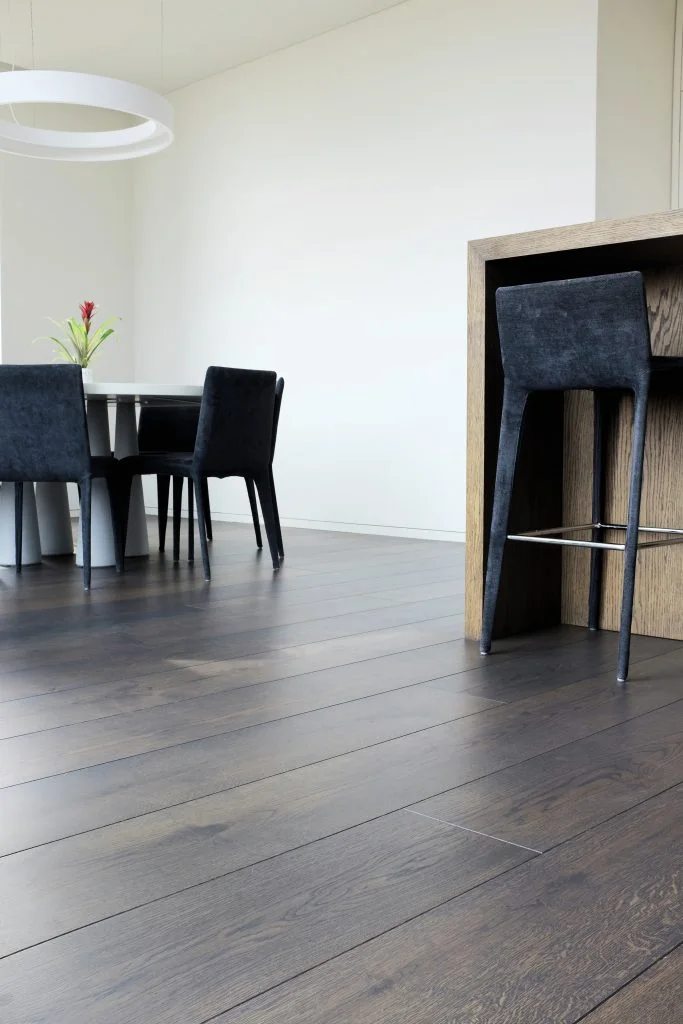
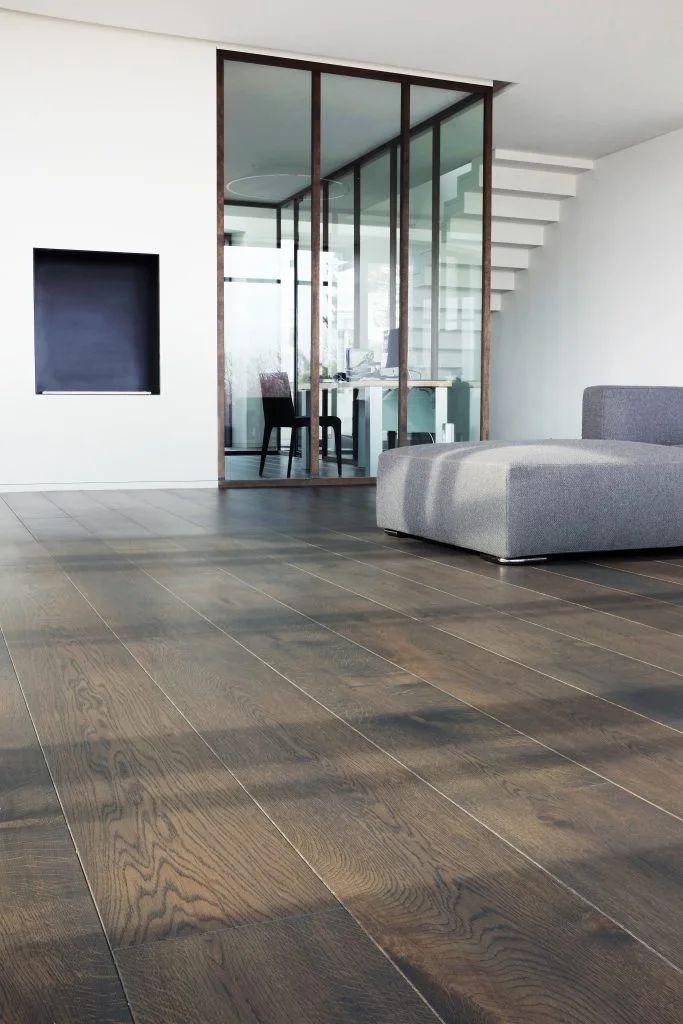
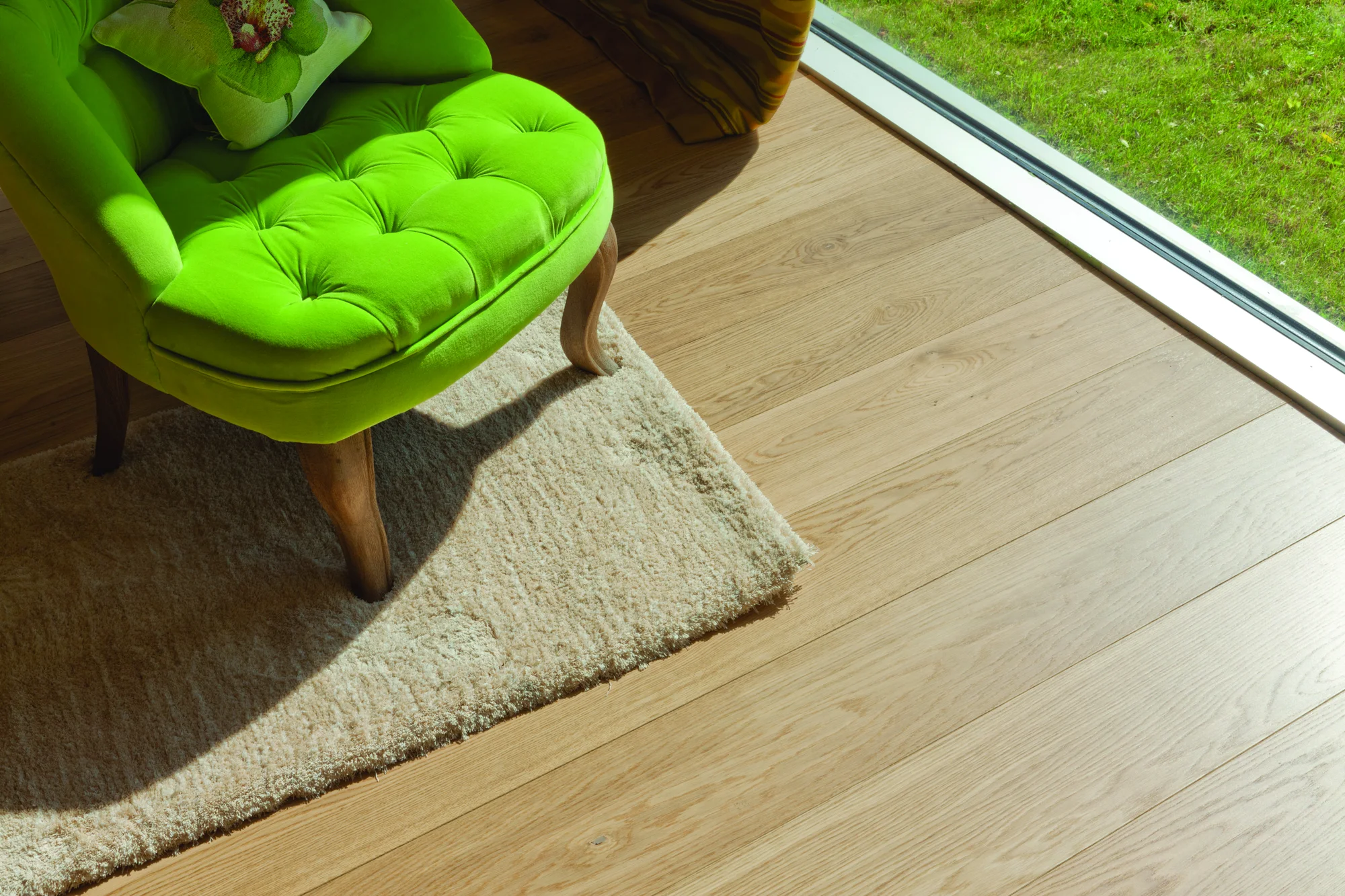
A finish is never completely invisible, and this is the point people most often overlook when choosing. Oils warm wood up: a clear oil or hardwax oil deepens the grain and gives oak a honey tone that grows richer over the first year or two. Water-based lacquers change the colour very little, so pale and white floors stay closer to their original shade. If you want the raw, almost unfinished look that is popular in Scandinavian-style interiors, ask for an "invisible" or raw-look finish, or a white-pigmented oil, which counteracts the natural ambering.
Coloured finishes are where oil really shines. Tinted hardwax oils let us take oak from bleached and white through greys and browns to near black in a single process – combined, when the design needs it, with smoking, staining or brushing. If you are matching an existing floor, a fabric or a piece of joinery, always look at a real sample with the actual finish on it. Order samples or come and see the boards in our Morningside showroom.
Which finish for which room?
- Kitchens: hardwax oil or matt lacquer. Lacquer shrugs off spills best; hardwax oil is easier to repair in front of the sink and the oven, where most wear happens.
- Hallways and entrances: hardwax oil, ideally with a good doormat. Grit is the enemy of every finish, and an oiled hallway can be refreshed in an afternoon.
- Homes with dogs and children: a matt or oiled finish on a textured, brushed surface hides scratches far better than a smooth satin lacquer.
- Bedrooms and living rooms: anything goes – choose on looks. Natural oil is at its best here.
- Rental properties: UV oil or lacquer, for the lowest maintenance between tenancies.
- Commercial interiors: a 2K lacquer, or a hardwax oil with a planned maintenance schedule, depending on whether you would rather recoat every few years or refresh more often without closing.
- Period homes in Edinburgh's New Town, Marchmont or Morningside: oiled finishes usually sit most comfortably with original joinery and cornicing. Our guide to flooring for Victorian and Georgian homes goes into more detail.
Can you change the finish later?
Yes, but only by sanding back to bare wood. Lacquer cannot be applied over an oiled floor – the oil stops it bonding – and oil cannot penetrate through a lacquer film. Changing from one to the other is therefore a full sanding and refinishing job. On solid wood that is never a concern; on engineered flooring it uses up one of the sandings the wear layer allows, which is one more reason to choose carefully at the start. A 4 mm or 6 mm hardwood wear layer, as on our engineered wood flooring, gives room for several full sandings over the life of the floor.
Looking after each finish
- Every finish: sweep or vacuum with a soft floor head (no rotating brushes), and use a well-wrung mop with a pH-neutral wood floor cleaner. Never use steam mops, vinegar, bleach or ammonia-based cleaners. Put felt pads under furniture and choose breathable rug underlays rather than rubber.
- Oiled and hardwax oiled floors: use a cleaner made for oiled floors, which leaves a little oil behind each time, and apply a maintenance oil when the surface looks dry or dull. Our guide on how often to oil wood flooring covers timings for solid and engineered floors.
- UV-oiled floors: as above, but always with the refresher oil recommended for that floor.
- Lacquered floors: clean only – no oils or polishes, which leave a slippery film. Arrange a maintenance coat before traffic wears through to the wood.
- Indoor climate: keep relative humidity around 40–60%. Very dry winter heating is harder on wood than any finish.
A safety note on oily rags. Cloths soaked in linseed-based oils and hardwax oils give off heat as the oil cures, and a crumpled pile can catch fire on its own, sometimes hours later. After oiling, lay rags out flat outdoors to dry fully, or store them under water in a sealed metal container before disposal. Never leave them screwed up in a bin.
How we finish our floors
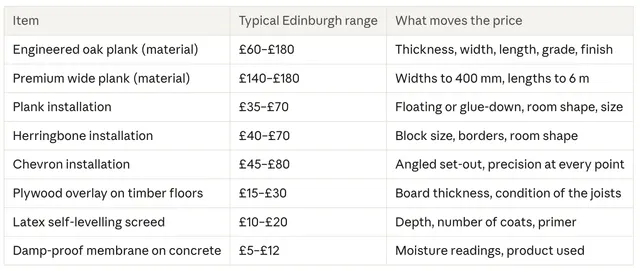
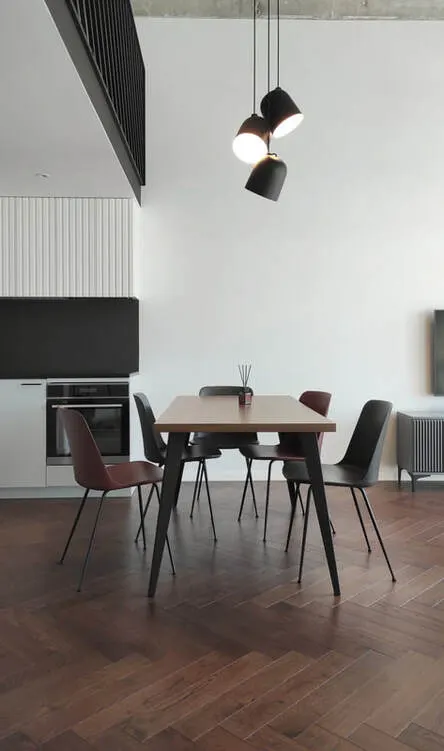
Most of our engineered and solid wood flooring is made to order, so the finish is chosen with you rather than taken off a shelf. Pre-finished boards leave the factory with either two coats of natural oil or eight coats of lacquer, and hardwax oil is our default for floors finished on site, from herringbone and chevron parquet to wide planks. For the ultimate control over colour, our unfinished wood flooring is laid bare, sanded flat and finished in place. If you are weighing up budgets as well as finishes, our 2026 guide to wood flooring prices in Edinburgh sets out typical costs.
Still undecided? Tell us how you live – children, pets, how you cook, how much maintenance you are happy with – and we will recommend a finish and send you samples to try at home. Call 0131 385 7779 or visit us at 37 Comiston Road, Morningside, Edinburgh.